


10/30/2026
Critical Materials & Resource Dependency
U.S. Department of Energy Adds Helium to Critical Material List as Pulsar Advances Domestic Supply Potential


On October 23, 2026, the U.S. Department of Energy (“DOE”) announced that helium had been designated a critical mineral under the Energy Act of 2020, citing its essential role in semiconductor manufacturing and exposure to supply-chain risks.
For Pulsar Helium, the designation provides relevant policy context for two separate initiatives: the development of its Topaz helium project and its proposed Rare Gas Hub, both in Minnesota.
The designation reflects a growing recognition that access to helium underpins industries central to American competitiveness. The DOE identifies applications including semiconductor manufacturing, quantum computing and essential medical and scientific activities. Its announcement also states that global demand is growing faster than production, while limited refining capacity and lengthy permitting timelines constrain U.S. output.
A domestic resource aligned with national priorities
Pulsar’s flagship Topaz Project is located in northern Minnesota. As a primary helium discovery unassociated with hydrocarbon production, it offers the potential to diversify supply beyond sources dependent on natural-gas processing. If successfully developed, Topaz could provide an additional domestic source.
Disruption to Qatari exports and Russian export controls have demonstrated how events affecting a small number of major suppliers can reach semiconductor manufacturers, healthcare providers and other helium users worldwide. A new U.S. source could give customers an additional option when seeking to diversify their supply arrangements.
Separately, Pulsar is advancing its proposed Rare Gas Hub in Two Harbors, Minnesota, intended to provide helium purification and liquefaction capacity.
A further connection to quantum technologies
Independent analyses have confirmed helium-3 in gas samples from Topaz’s Jetstream #1 well. This rare isotope is used with helium-4 in dilution refrigeration for certain quantum-computing systems. Pulsar’s evaluation agreement with Lunar Helium-3 Mining (“LH3M”), announced on October 14, 2026, is designed to assess the technical feasibility and preliminary economics of recovering helium-3 from Topaz gas. The evaluation remains at an early stage, and there is no assurance that recovery will be technically successful or commercially viable.
The historical price context
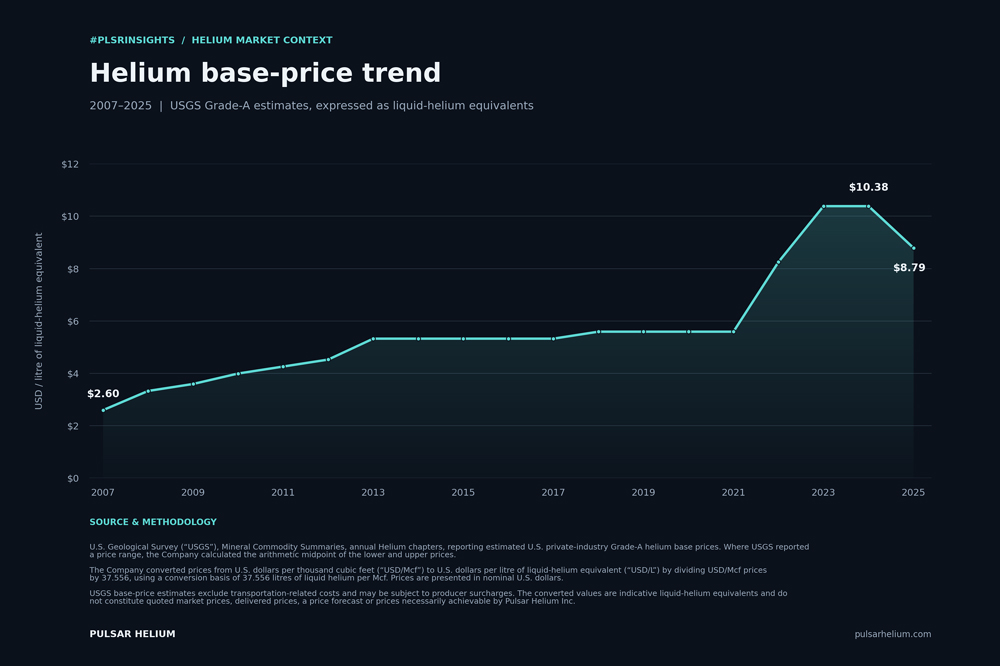
The accompanying chart presents historical USGS estimates of U.S. private industry Grade-A helium base prices, converted by the Company into liquid-helium equivalents. The converted figures provide historical context only; they are not quoted market prices or delivered prices.
Summary
DOE’s designation highlights the importance of resilient helium supply chains. Pulsar’s Topaz project and proposed Rare Gas Hub represent separate potential contributions to that objective.
Follow #PLSRINSIGHTS for more insights into helium and the critical industries it supports.
Pulsar Helium’s shares trade on TSXV: PLSR | OTCQB: PSRHF | AIM: PLSR
Disclaimer
This article contains information based on current market conditions and publicly available data. It does not constitute financial advice, and investors should conduct their own due diligence before making any investment decisions.
Marc Farrington
PR & Partnerships
marc@pulsarhelium.com#PLSRINSIGHTS
Follow us on X


